About 20-30 years ago, there seemed to be a shift from Inline-6 to V6 (or V8).
Like with the Land Cruiser and Jeep/Chrysler Products. And many other products. It seemed like the V configuration was the most desirable from a manufactures POV.
And now, there seems to be a shift from V6 (or V8) back to Inline-6, like with Hemi to Hurricane. And Mazda is even getting into the fold with brining in the Inline-6 into the lineup in the near future.
What is the reason of the shift from Inline-6, to V6, and back to Inline-6?

It's easier to work on because in a V6 or V8, you have multiple cylinder heads, camshafts and catalytic converters. It also saves automakers money. With an I6 compared to a V6, it's less complex and you'll get smoother driving. The problem with them is that they can be long when trying to fit it in the engine bay.

You have to look at the pros and cons of each configuration. I'm pretty sure Scotty has done a documentary style video about this.
The 'V' configuration crams more cylinders into a smaller space, leading to shorter engine blocks. This allows you to put an i4 or a v6 in the same space on a small car. They run smoother and I think offer more torque too. People could afford more powerful engines back in the 80's.
I haven't seen many straight 6's recently. I think inline-4 is the direction everyone is going now. This is simply due to fuel prices and pressure from the government to improve fuel economy and emissions. To increase power and efficiency, they just stick turbochargers on them.

V6s became popular because the V arrangement produces more torque than the equivalent straight engine, and the V6 is quite compact and powerful for its size. A V6 is as long as a straight-3, which goes into a FWD car quite well, especially the smaller cars that came out in the 80s and 90s. The extra space allows manufacturers to put in a transmission much more easily.
The straight-6 is dynamically balanced, meaning there are no problematic vibrations inherent to the design when it's running. The same number of pistons are always moving up and down. The V6 isn't this way, and needs counterweights or balance shafts to offset vibrations. Straight-6s are easier to engineer, but don't fit well in small cars.
My guess with the return to the I6s, they're taking advantage of the smoothness of the engine, and the larger engine bays that these bigger SUVs and cars have, especially ones that are RWD or RWD with optional AWD. BMW has pretty much always made I6s, they are quite smooth engines and put out good power. They are long, but the RWD drivetrain goes favorably with the choice.

Packaging is a big part of the reason for the move to V6s. A transverse engine FWD setup is a lot tougher to pull off with a straight six. However it can be done. Checker Motors built prototype FWD taxicabs (the "Model D") with transverse straight sixes in the 1940s right after the war. In more recent years, the late and unlamented Daewoo Laganza had a transverse inline six, as did Volvo models equipped with their SI6 engine.

how'd they jam it in there? Small bore cylinders? compromise on suspension?
Not sure on the Checker, photos online of the prototypes (which were actually tested extensively in taxi service) don't show under the hood. However Checkers were large cars and a compact flathead six was used. It is reported that they did quite well in testing but the idea was abandoned due to cost and servicing issues (FWD was very uncommon at the time).
The Daewoo engine was designed to be very compact and was limited to a maximum of 2.5 liters:

Here's a photo of the Volvo transverse inline six under the hood:
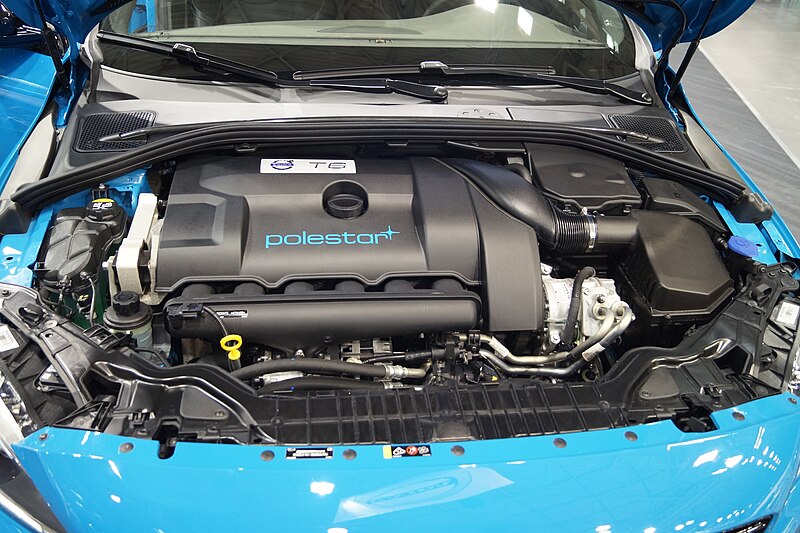
not much extra space in that engine bay at all
Nope, very cramped in there. I'll bet a lot of stuff has to be disassembled to to pull the engine out.
IMHO the best 6 cyl engines made were I6's
Dodge 225
GM 250
Ford 300
AMC 4.0

You don’t think highly of the BMW straight 6, or the Toyota 2JZ?
don't know or care about foreign made engines. could maybe be a few.
I recall that Ford made a 200 cu. in. 6 that was pretty short.
And I'm pretty sure that inlines produce more torque than vee's
maybe per cu. in. of displacement, but not per square foot of engine space used.
That was the old Falcon six, which started out with 144 cubic inch displacement in 1960. The early series Rambler inline sixes (195.6 cubic inches) were based on a 1930s design and were also very compact.