In terms of performance, at the same horsepower, why are more cylinders better than less. For example, why is a 300hp V8 better than a 300hp V6 (or 300hp V6 with turbo)?

8 cylinders means each cylinder has to perform less work than in a 6 cylinder engine to produce the same power.

Nice mental heuristic. Thanks!
More cylinders mean more power per unit of time. For example, a 4-cycle lawn mower with a single cylinder needs to perform 2 full rotations to get to the next power stroke. With a V8, the engine needs to only rotate 45 degrees to get another power stroke. A V12 needs to move 30 degrees. A V6 needs to rotate 60 degrees. More cylinders =more power and smoother delivery.

I think you forgot that every SECOND stroke of the piston is a power stroke, therefore for a V8 it's 360deg divided by 8 TIMES 2 = 90 degrees
That's right. Two pistons would fire every 360 degrees. I was partly distracted at the store when I got to those parts. Haha.
Four
I guess now I'm confused how you got to that. 720 degrees (2 revolutions) for a complete power cycle from power stroke to power stroke. Divide that by two, since we have 2 cylinders, then multiply by two revolutions again? That gets back to a full 2 revolutions, 720 degrees. I'm Probably brain farting at this point for something stupid. haha.

who said "more is better". What does "better" even mean? What kind of "performance"? Every design has it's own characteristics , and engines are matched to an application.
And I'm pretty sure this question was already asked in the forum.
As was discussed before, HP alone is a pretty meaningless number.
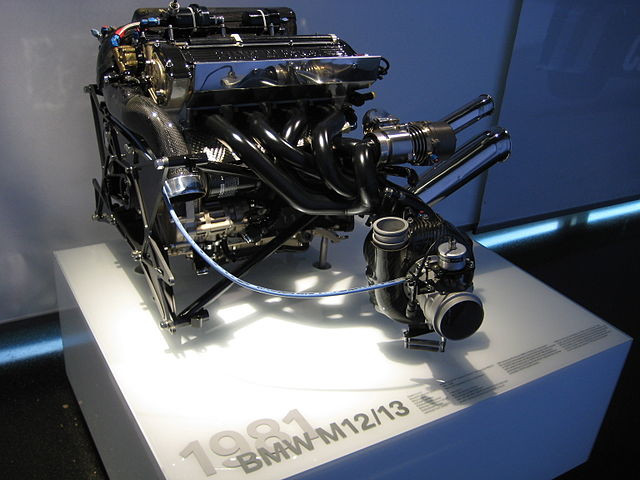
This is a 1986 BMW M12 turbocharged 1.4L I-4 engine. It makes around 1,400 hp
It won many races. In the Italian Grand Prix, Gerhard Berger's car (with the M12) went 352.22 km/h (219 mph), the fastest speed recorded by an F1 car at the time, and indeed the top five cars through the speed trap at Monza were all powered by the BMW M12.
This is a Bugatti quad-turbo 8.0L W-16 Veyron engine. It makes 1,184 bhp. It goes from zero to 100 km/h in 2.6s. It set a Guinness world record for fastest production car (431 km/h / 268 mph)

This is a Cummins QSK38 37.7L V12 Diesel engine. It makes 1,000-1,400 hp and cranks out 4,400ft-lbs at only 1,800 rpm. It weighs 11,000 lbs. (you can find such engines in different varieties from 4 to 16 cyl)

This is the Finnish Wärtsilä-Sulzer RTA96-C, the world's largest reciprocating engine.
(Designed by the Finns and manufactured in Japan)
The two-stroke turbocharged 14-cylinder diesel engine produces 80,080 kW (107,390 hp).
Displacement: 1,828.7 litres per cylinder
It red-lines at 120 rpm.
H: 13.5m/41ft L: 26.6m/87ft
Weight: 2,300 metric tons.

The crankshaft:


The turbo:

Here it is starting up
https://www.youtube.com/watch?v=pwvS8_H5rKs

Those are some crazy big engine!
More cylinders mean more power per unit of time.
Simple way to put it. Thanks.
yup , however more cylinders = more weight
You can also make more power by spinning less cylinders faster. (see M12 above)