The owner's manual for Lexus GS300 1995 says:
Only do a slow charge (5 A or less). Charging at a quicker rate is dangerous. The battery may explode causing personal injuries.
The battery: EverStart - Group size 34 - CCA 750. I could not fine exact specs for it. Below is just a general web search:
Generally speaking, group 34 batteries have a 20h capacity in the 50 to 75 Ah range. Most also provide 750-900 CCA (cold cranking amps) and around 100 to 145 minutes reserve capacity.
Can I charge my battery at twice higher amperage (10A vs 5A)?
I can only get access to a 10A charger.

Yes , but do it outside, monitor it, and don't leave it unattended for long periods of time like overnight.
10A and up is used when you want to completely charge up a battery that was drained.
If you are just trying to "float", "trickle charge" or maintain a battery, you should use 2A or less.

you should provide more detail when asking these questions, like why you're charging it.
You answer perfectly answers my question. But if the good man Joe insists, it's because the engine dies right after the start, and I've been trying to fix the issue for a month. When cranking (spark/compression/fuel testing), the battery gradually depleted. Now it shows 12.3V between the terminals. It's time to recharge and to continue diagnosing the root problems.
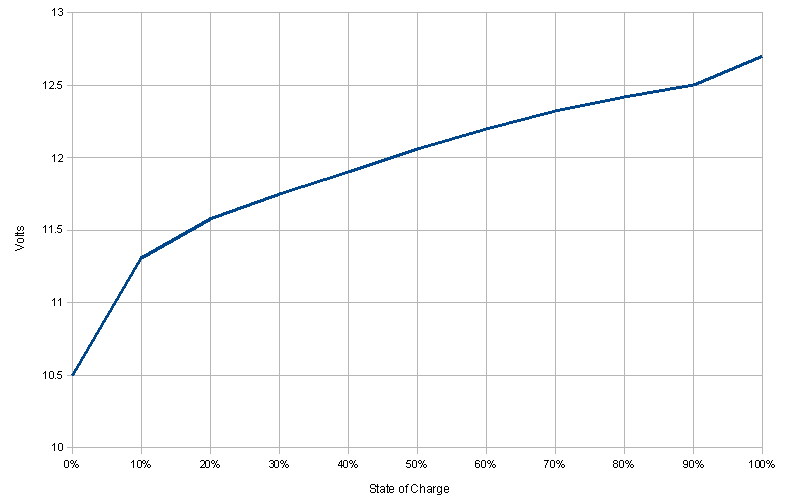
Gotcha. Well 12.3V is around 75% full. In fact that should still start the car.
You don't need leave it on 10A for very long to fill it up.
Thanks! Some people say that batteries below 12.3V are way too depleted and might not start a car. I asked to charge my battery for 5 hours at 10A (because I assumed that the battery is 25%full at 12.3V)
nah. When it gets below 11V is when you have problems. I just started a 5.3L engine perfectly a few minutes ago when I had about 11.5V
5h @ 10A = 50Ah which is too much.
Here's a chart from the battery wikipedia article.
I personally wouldn't risk it unless it's a dire situation. Putting too much amperage through the battery overcharges it like a bad alternator does, and it can give off hydrogen gas, which can explode with even the smallest spark. Even if the gas stays contained in the case, the battery can get hot and you'll risk blowing it up inside the car. It'll blast 30% sulfuric acid and lead all over the inside of the engine bay, or wherever you're charging it. Under the hood of a newer car, it'll easily destroy very expensive electronics stuff. My girlfriend's dad did this under the hood of my 1979 Pontiac when it was his car, and it didn't do anything but corrode the car's steel a bit because there are next to no fancy electronics inside. At the least, you'll probably reduce your battery's lifespan.

In the future, invest in a modern electronic battery charger. About 15-20 amps should be good.
The electronic ones automatically reduce amperage to safe levels as the battery voltage returns to normal.
Some can test alternators, give battery voltage readings, and automatically shut themselves off if the battery is faulty or the polarity is wrong.
Very nice all in one tools.

I second Carlos. A 5 amp battery charger costs $30-$60, and replacing an overcooked battery is over $100.
Right. It's a good device if you have a garage or access to unconfined space with mains electricity.
Yes
