Dear Scotty!
Am a great fan of your vids, including those dedicated to the history of automobiles.
Maybe you could answer my question: why do most cars have engines at the front?
I mean, this seems somewhat illogical: technically, it is pretty much irelevant where to place an engine in a car - with proper design, any location would work (and does work - since there are a few cars with engines placed in the middle or at the rear). However front engine layut seems to be most common for cars, despite its having serious disadvantages- to name just a few out of the top of my head, engines placed in front of the driver
1) obstruct visibility;
2) make maneuvers more difficult (or even dangerus, due to uneven weight distribution with too much weight at the front);
3) since the engine is argualbly the most valuable part of any car, placing it in an area most endangered in case of an impact appears a bad move;
4) If I am not mistaken, historically most cars had rear wheel drive - so why place the engine at the opposite end of the car, creating an unnecessary hassle of interconecting the front engine and the rear wheels via an additional huge and heavy shaft?
5) As to accessibility and cooling, technically these two requirements are not difficult to fulfill even for an engine placed in the rear of a car.
For a rear wheel drive car layout, having the engine where the drive wheels are also gives the additional benefit of better acceleration thanks to less wheels slippage (since in this constellation the drive wheels are additionally pressed against the ground by the weight of the motor, thus providing more traction).
Is it purely a tradition to have the motor mostly at the front? Or does it have a practical explanation? Thank you.

You just can't get around the simplicity of having a water-filled radiator in the oncoming airstream for cooling. Cars are much larger than motorcycles and lawn mowers, so purely air cooling does not work very well on the larger engine needed to move the car. Air is a bad heat transfer medium unless you have a ton of it. Water is extremely good at absorbing heat, and high speed air flow through a large, water filled radiator can dissipate heat much more effectively than air over metal fins alone. Also, the car needs to be relatively aerodynamic, given its size. A motorcycle is small, and its width is almost perfect for air cooling because the cooling fins for the cylinders protrude into the air relatively easily. It's extremely inefficient to put a radiator at the front of the car and engine at the rear, so air is the only real way to cool a rear engine car. Replacing feet of rubber cooling hoses wouldn't be fun to do, going the length of the car. Consequently, most have been rather small. The Chevy Corvair is a rear engine, RWD car and air cooled. The car is small, so the engine can move it, and there are lots of channels for air to flow through the rear end. Same with the original VW Beetle.
Then, as Chuck mentioned, there's the problem of stability. Vehicles are designed to be dynamically stable, meaning if they are disturbed by something as they move, be it wind, bumps, etc. they are designed to return to how they were oriented before the disturbance took place. Objects "like" to have their CG closest to the direction they're traveling. If they don't, they want to pivot in that direction, especially from the wind. This is why a metal wind arrow with the chicken on top points in the direction of the wind. The part with the arrow head is slightly lighter than the tail. There's a term for this, and it's escaping me at the moment. In Chuck's story, the rear of the old Beetle is heavier than the front, so the wind wants to pivot it so it points forward. This is counter to the vehicle's design and difficult to engineer against.
Mid-engine cars are designed for performance and are generally very expensive. A centered weight gives the car the most optimum handling characteristics, so engineers deal with the issues like cooling by basically just making it work, for lack of a better way to explain it. They're 2-passenger cars, so they can utilize the entire area where a back seat would be to make the engine and radiator fit back there. They route air through a radiator behind the driver and then out behind or beneath the car. Lamborghinis have those big, gawdy intakes behind their doors to cool the engine. They're highly engineered machines to provide performance.

"There's a term for this, and it's escaping me at the moment. "
You almost had it. Are you thinking of the weathervane effect?
That's it, it's called weathervaning. Haha. I couldn't even remember what a weathervane is called. Parked airplanes at the airport will do it as well, in a strong enough wind, a 747 can turn into a massive weather vane.
Sailboats too. They call it weather helm.
I used to have a first-generation Corvair a long time ago. If you took a curve at speed you could definitely tell that air-cooled flat-six engine wanted to swing around and hit you in the mouth.
I'll have to keep that in mind when we get the '65 going again. I'm a big Mustang fan and have seen Ford advertising from 1965 trying to out the Corvair as the "bad" car because the rear ends could swing out if you turned too fast
@mmj I didn't really think about sailboats. My step dad would know that one. He used to sail in the East River and off Long Island back in the day. He has a little two-man clipper, but he doesn't take it out anymore.
The keel acts as a fulcrum around which the boat pivots. The aim is to keep the forces around it balanced, or else too much input is required to steer. Many factors act on this rotational moment of the boat, sail shape and angle, heel of the boat, mast stay tension etc. Sailing can be a real exercise in applied physics! My friend and I have been learning on his new Catalina 30 in Pacific coastal waters. Great fun.
@justin-shepard, the 1965 second-generation Corvair has much better handling due to getting rid of the swing axles in the rear in favor of a real articulated independent suspension. You do still have watch that rear weight bias though.
Surely you must remember when there were many rear-engined cars being sold, even in the U.S. They fell out of favor in large part because the extreme rear weight bias makes for tricky handling and sensitivity to cross-winds. (Ever drive a VW across a bridge in a heavy wind?) In fact during the war it was said that more German officers were killed driving Tatras at speed, with their rear-mounted V8 engines, than in combat. It was unofficially known on our side as "the Czech secret weapon".
https://www.warhistoryonline.com/war-articles/czech-car-killed-nazi-officers-than-active-combat.html


why do most cars have engines at the front?
Stability. Cars manoeuvre better in wet/snowy conditions when the powered wheels pull the weight of the car, rather than push it. And of course you want the weight of the powertrain on your powered wheels for traction.
1) obstruct visibility
Not really. There needs to be a pointy front for aerodynamics. Might as well stick an engine there.
For a rear wheel drive car layout, having the engine where the drive wheels are also gives the additional benefit of better acceleration thanks to less wheels slippage (since in this constellation the drive wheels are additionally pressed against the ground by the weight of the motor, thus providing more traction).
4) If I am not mistaken, historically most cars had rear wheel drive - so why place the engine at the opposite end of the car, creating an unnecessary hassle of interconecting the front engine and the rear wheels via an additional huge and heavy shaft?
2) make maneuvers more difficult (or even dangerus, due to uneven weight distribution with too much weight at the front);
Quite the opposite. You want most of the weight over the wheels that steer
Have you ever seen a forklift that lifted a little much weight. The rear (steering wheels) do not have sufficient traction and you lose the ability to steer.
3) since the engine is argualbly the most valuable part of any car, placing it in an area most endangered in case of an impact appears a bad move;
(A) Most collisions are between two vehicles. The front of one is demolished, and the rear of the other.
(B) The most vulnerable component is the gas tank
5) As to accessibility and cooling, technically these two requirements are not difficult to fulfill even for an engine placed in the rear of a car.
In the era of air cooling, much more difficult.

Interesting point - all the early, air cooled 9ll Posches were rear engine cars and inevitably, when they crashed, they crashed the rear end of the car. As a matter of fact, Porsche actually used ballast weights in the front of their early 911s to help with the balance. Most of the '70 era cars had two batteries in the front, not for electrical power but for weight distribution and better handling. These were very "tail happy" little cars.

Imho, it’s because the first mass produced vehicle, the Ford Model T, was a front engined car. Copycats ensued.

nobody cares about that lol. These days safety and fuel economy dictate everything.
Why is it safer to have the engine in the front that the rear?
Why is having in the engine in the front more fuel efficient than the rear?
See all the above answers for safety.
Engine location isn't necessarily more efficient. I'm just saying economy numbers play a much bigger part in car mass production than copycatting does.
But having the engine directly over the drive axle drastically reduces component count, cost of production, and weight, which does make it more efficient.
If putting a giant banana on the roof of a car made the economy higher, emissions lower, and cost lower, they would absolutely do it! Most people have no idea what a Model T is. If you asked, they would think it's the newest Tesla.
Although the Ford Model "T" famously made cars affordable to the masses, the first mass produced vehicle in the U.S. was actually the curved-dash Oldsmobile produced from 1901-1903. It was a mid-engine design with the engine located under the seats.
https://en.wikipedia.org/wiki/Oldsmobile_Curved_Dash
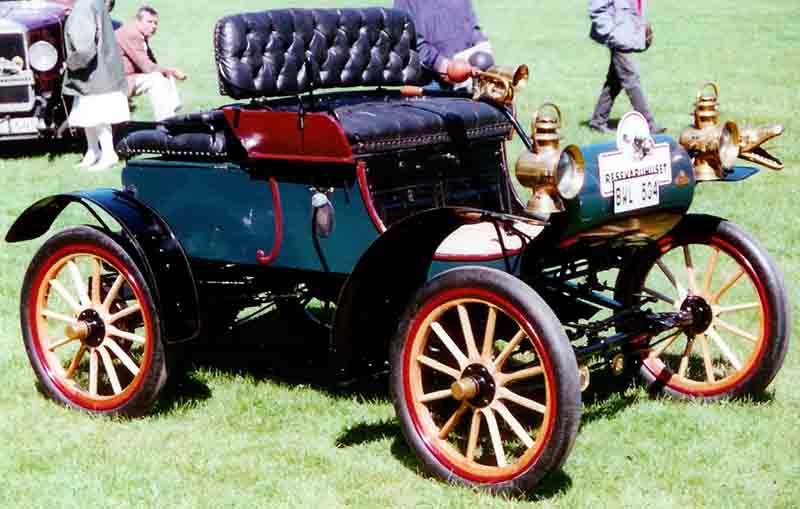
it's a horeseless carriage!
First affordable mass produced, to be more accurate about the Model T.