I've noticed that vehicles with a FlexFuel tag only have the ability to run a limited eathonol content of 85% eathonol. In Brazil though, most of their cars can run pure eathonol, why is that? Why can't cars in the u.s. and Canada have the ability to run it? And before anyone says it, I know the eathonol has 20-30% less energy content meaning you need more for the same power, but that's not what I'm talking about in this post. I just want to know why pure eathonol cars are highly rare in the u.s. when the abundance of crops to make it is readily available in storage and straight from the prossesing plant.

Ethanol is harsh on rubber parts and attacks them. It attracts water, which corrodes fuel injectors, fuel lines, fuel pumps... Vehicles need to be completely re-engineered engineered to accept 100% ethanol. That is extremely expensive.
There is no market nor is there a good supply ethanol supply crop in the U.S. to produce pure ethanol fuel. Corn, our stereotypical crop here in the Midwest, isn't nearly as efficient to convert to ethanol as sugar cane. We don't have the climate to grow sugar cane really anywhere except maybe Hawaii. There's not much land in Hawaii to grow stuff on, and live on. Brazil is almost completely in the tropics, is not much smaller than the U.S., and can easily support sugar cane farms. Fuel tanks need to be bigger to get comparable range to gasoline, which changes how space is divided in the vehicle, among many other things.

@Justin-Shepherd thanks man
A lot of political reasons.
Brazil was dependent on imports for 80% of its oil supply. The sharp fall in oil prices in the 1990s led to the near-collapse of the ethanol market in Brazil, as consumers reverted to buying gasoline fuelled cars. From the early 2000s, the rising price of oil put ethanol back on the political and economic agenda, as it was reframed and promoted as a “green” fuel alternative through promotion of flex-fuel vehicles.
The Proálcool programme evolved under bold policy in Brazil. They had to reconfigure their entire economy and convert a lot of land. An authoritarian government is able to steamroll changes a lot quicker than in a free country like the one you live in.

Even Brazil struggles to keep up.
In 2011 ethanol production dropped and there was a major shortage.
"prices climbed to the point that ethanol fuel was no longer attractive for owners of flex-fuel vehicles; the government reduced the minimum ethanol blend in gasoline to reduce demand and keep ethanol fuel prices from rising further"
for the first time since the 1990s, ethanol fuel was imported from the United States
As a result, by November 2013 only 23% flex-fuel car owners were using ethanol regularly, down from 66% in 2009.
I also forgot the controversy here in the U.S. about using corn for fuel instead of food when we have hunger issues.
There's also a whole lot of demand for corn for animal feed, in addition to consumable corn for people, just about everything that's artificially sweetened is made from high fructose corn syrup in this country. We also produce a ton of ethanol for human consumption in alcoholic beverages. Sugar cane really only has one use, as a sweetener.
Brazil though, most of their cars can run pure eathonol,
Also not true. Cars that run on pure ethanol (neat) have mostly vanished. Most are "flex fuel".
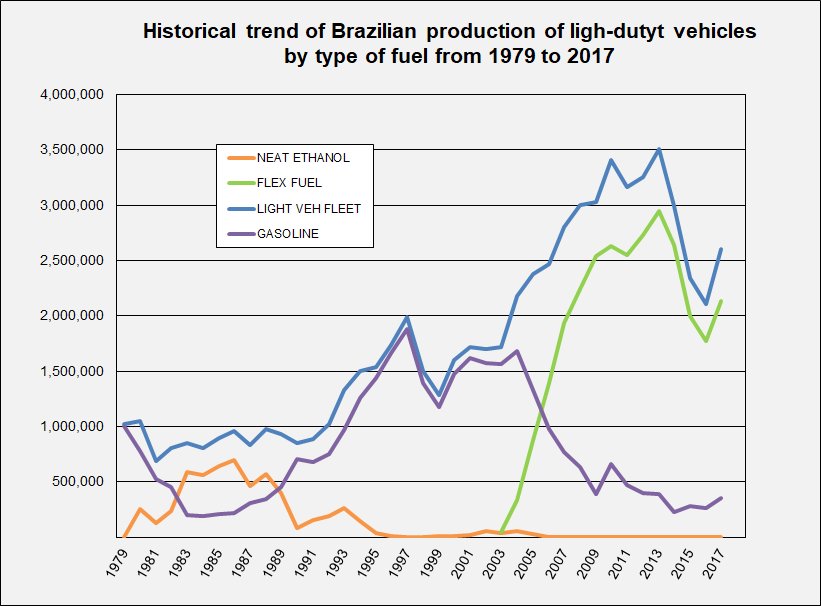
@mmj oh, I thought their cars did run 100% eathonol. I guess that was in the 80's. Although e100 is still used as race fuel so if someone really wanted to they could modify their car to run straight eathonol and make high quantities of high proof moonshine filtered out to be only eathonol and run their car on homemade eathonol, changing the cost from money per gallon to labour per batch or something like that.
HAH!
Barbara, start the still! I need to go for a drive.
It's illegal.
@mmj actually if you have a license to make alcohol, its completely legal.

of course it is. I wouldn't be able to buy it otherwise.
John home-owner isn't going to get into mass production of spirits so he can get to work.